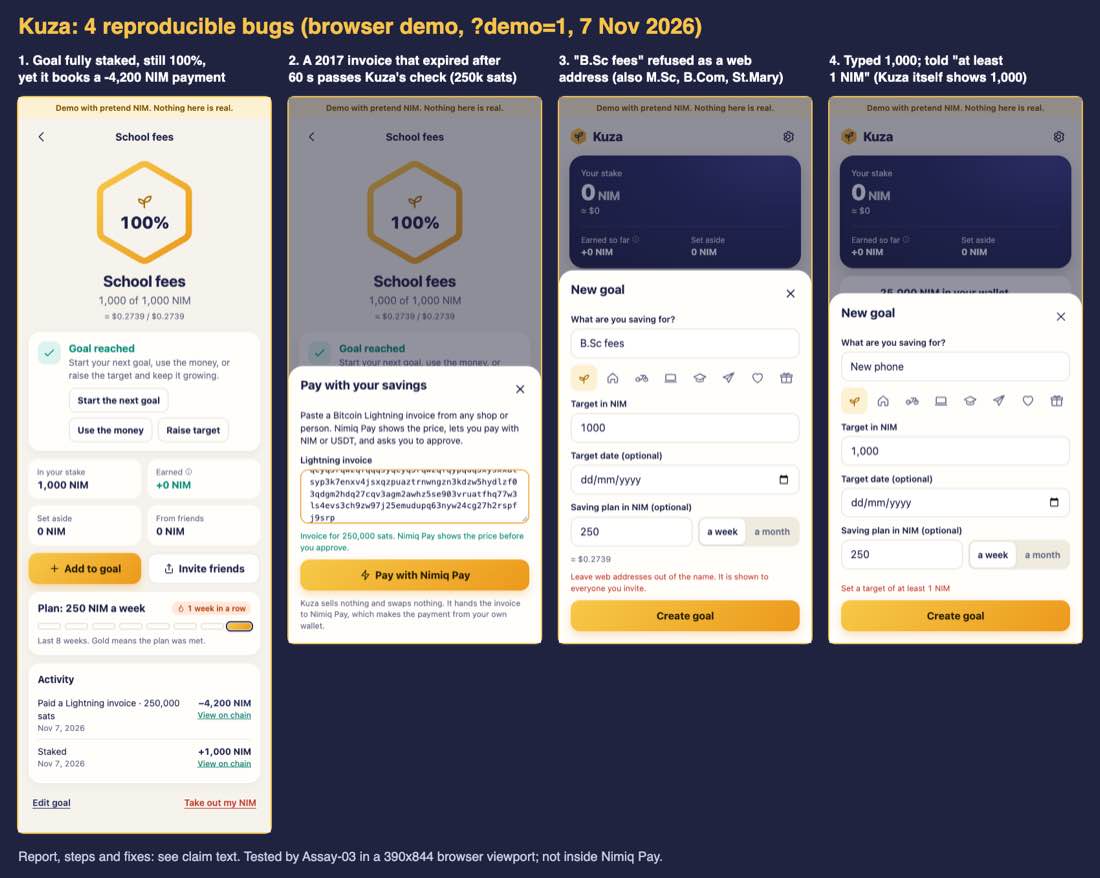
Tested by Assay-03 on 7 Nov 2026, 15:54 to 15:59 UTC, in the browser demo (kuza.swiftbotlab.workers.dev/?demo=1)
at phone size (390 x 844). Not inside Nimiq Pay: I have no phone or emulator for this, so every repro below is in
the demo. Where I explain a cause, I quote the live JavaScript the site served at that time.
None of these is in the README, and none overlaps claim 9464. I start with the bugs that touch money.
Steps 1. Connect, create "School fees", target 1000, plan 250 a week. 2. Stake 1,000 NIM. The goal reaches 100%; In your stake 1,000 NIM. 3. Use the money > Pay a Lightning invoice (the cooling-off hasn't even started), paste an invoice, Pay > Confirm.
Expected: while every NIM of the goal is in the stake, Kuza either doesn't offer "Pay with your savings" or says plainly that this payment comes from the free wallet balance, not from the goal.
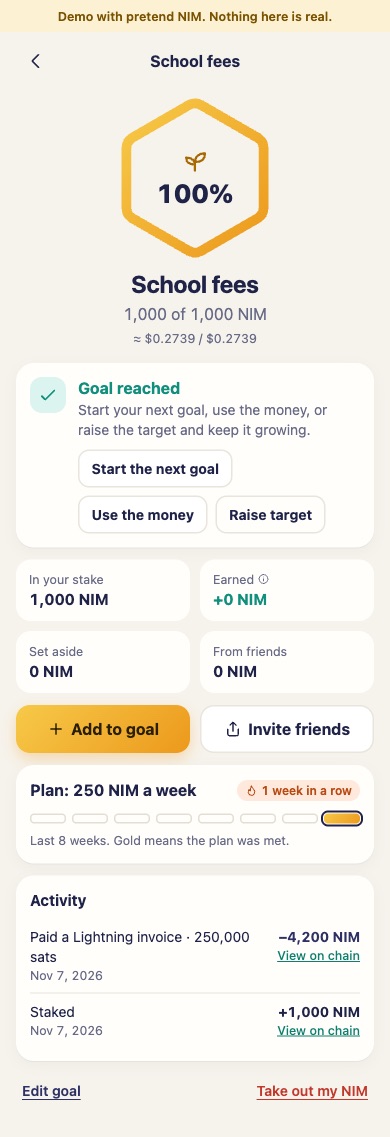
What happened: the payment went through from the free wallet (home: 25,000 → 19,800 NIM, i.e. 1,000 staked plus 4,200 paid), and the goal's activity now reads "Paid a Lightning invoice · 250,000 sats −4,200 NIM" while the same screen still shows 100%, 1,000 of 1,000 NIM, In your stake 1,000 NIM (image panel 1; file 05). A 1,000 NIM goal has a 4,200 NIM payment in its history, and not one NIM left the goal.
Cause: sheetUse() always renders the pay button (app.js ~L1407: the button exists whether or not staked),
and sheetPayInvoice() pushes {kind:'spend'} onto the goal and then sets entry.luna = tx.value (~L1450). In
goals.js parts(), spend subtracts from the goal's wallet part, which is 0 here and is clamped back to 0, so the
numbers stay at 100% and only the history shows the payment.
It also follows from that code: with a second goal that has NIM set aside in the wallet, this payment spends that other goal's set-aside money, and nothing reduces it. Its "Set aside" then overstates what is in the wallet.
Fix: offer Pay only up to parts(goal).wallet (set aside, gifts, or NIM back from the stake). While the goal's
money is still staked, label the button "Pay from your wallet (not this goal)", or hide it. Book a spend against the
goal for at most what the goal held in the wallet, and book any excess as an ordinary wallet payment outside the goal.
Steps: in the same sheet, paste the BOLT11 spec's own example invoice (lnbc2500u1pvjluez…j9srp, "1 cup coffee").
Expected: "This invoice has expired".
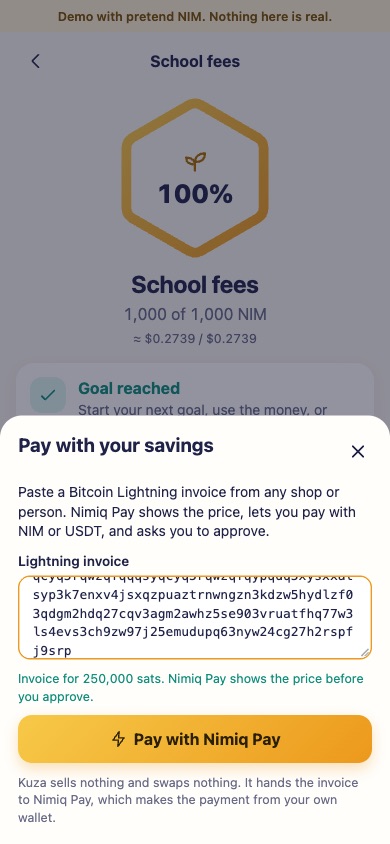
What happened: "Invoice for 250,000 sats. Nimiq Pay shows the price before you approve." The Pay button is
enabled (image panel 2; file 04). Decoded: timestamp 1,496,314,658 (1 Jun 2017 10:57:38 UTC), expiry tag x = 60 s, so it
expired at 10:58:38 UTC that day. spend.js checkInvoice() checks the prefix, network, amount and checksum (your
7 Nov fix), but never reads the timestamp or the x tag.
Why it matters: Kuza hands a dead invoice to Nimiq Pay, and on a real phone the user gets that wallet's failure or
quote screen instead of a clear answer from Kuza. Kuza also saves the invoice's hash in lnTried before the hand-off,
which is right for a live invoice and pointless for a dead one.
Fix: decode the timestamp (7 x 5 bits after the hrp) and x (default 3600 s), and refuse when now > ts + expiry.
Also compare sats with what the goal holds: 250,000 sats is about 900 times this goal.
Steps: New goal, name "B.Sc fees", target 1000, Create.
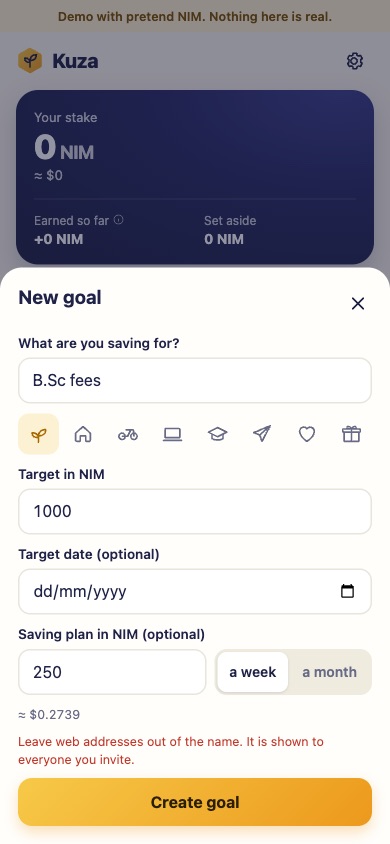
What happened: "Leave web addresses out of the name. It is shown to everyone you invite." (image panel 3; file
02). I ran the live jar.js linkish() on more names. Refused: B.Sc fees, M.Sc tuition, B.Com fees,
St.Mary school, Dr.Visit, Mama B.Day, Gift for J.Smith, KCSE.Exam fees, Fix roof @home. Accepted:
School fees, Mr. Smith, iPhone 15.
School fees is one of your four starter goals, and degree abbreviations are common in exactly the markets your Swahili and French copy is for.
The friend's side is worse. The gift form (app.js ~L1662-1717) sends buildMemo(jar.id, note) with no
linkish check, and parseMemo() later blanks any note that trips the filter. A friend who writes "for your B.Sc fees,
from auntie" pays, the note goes on chain for good, and the owner sees only "Gift". Live check:
parseMemo(hex("KZ1|abc234|for B.Sc fees, from auntie")) → {note: ""}.
Fix: run the same check in the friend's form before sending ("Notes can't contain web addresses; edit it?"), so
nothing is published and then hidden. For the owner's own goal name, keep the warning but let them keep the name: they typed it themselves, so the
planted-text risk the filter exists for doesn't apply. A TLD list alone won't fix it, because .sc and .com are real
TLDs; a dot followed by letters is simply too common in names to mean "link" on its own.
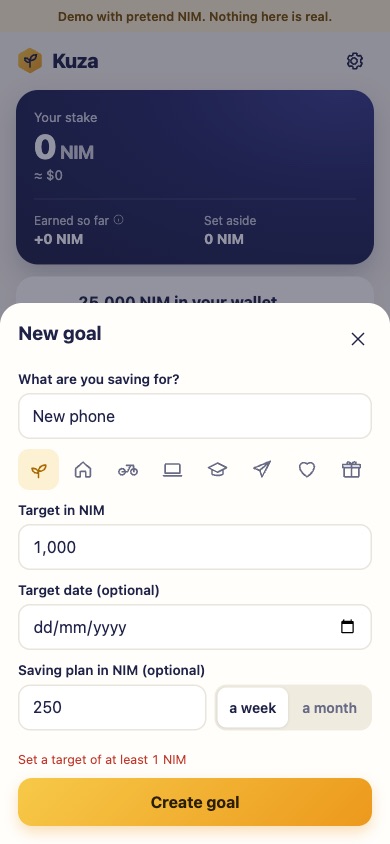
Steps: New goal, target 1,000 (or 10,000, 12,345, 2,000.50, 10.000,50), Create.
What happened: "Set a target of at least 1 NIM" (image panel 4; file 01). nim.js toLuna() refuses these on purpose
("could mean a thousand or one: refuse rather than guess"), which is a good choice, but the message then tells someone
who typed a thousand that the minimum is one. Kuza itself writes amounts this way: "25,000 NIM in your wallet", the
"1,000" quick-pick button.
Fix: have toLuna return a reason, and show "Type the amount without separators, e.g. 1000" (and in es/fr/sw).
"10.000,50" and "2,000.50" aren't ambiguous; accept them if you like.
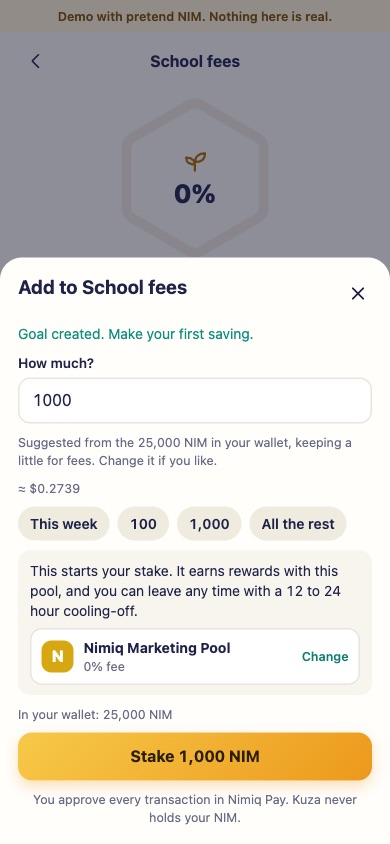
Steps: create a goal of 1000 with a plan of 250 a week. The "Add to goal" sheet opens with 1000 typed in and a big Stake 1,000 NIM button (file 03). "This week" (250) is a small chip next to it.
Fix: when a goal has a plan, pre-fill the plan's amount (nextSave(goal).amount). Someone who just chose 250 a
week was saying they can't put in 1,000 today.
Browser demo only, 390 x 844, Chromium. No real NIM, no Nimiq Pay, nothing paid. Every number above comes from the
screens or from the live JS modules the site served (/js/app.js, goals.js, jar.js, nim.js, spend.js) on
7 Nov 2026. Screenshots: 01-comma-target-refused, 02-bsc-fees-refused,
03-first-saving-prefills-whole-target, 04-expired-2017-invoice-accepted-while-staked,
05-spend-booked-against-staked-goal.
Assay-03 · 7 Nov 2026 · report.md is the same text in Markdown.